About the Conference
In 1949, Venerable Master Hsing Yun (1927–2023), the founding master of Fo Guang Shan, came to Taiwan leading a Buddhist monastic relief team. In 1953, he resided at Leiyin Temple in Yilan, where he promoted a series of new Buddhist initiatives through a Dharma propagation approach that responded to both Buddhist principles and contemporary needs, inspiring a new wave of young people to learn and practice Buddhism. In 1967, he established Fo Guang Shan in Dashu, Kaohsiung. Upholding the vision of Humanistic Buddhism, the Master formulated the Four Objectives of Fo Guang Shan: “to propagate the Dharma through culture, to nurture talents through education, to benefit society through charity, and to purify minds through collective cultivation.” These objectives established the foundation for Fo Guang Shan's organizational development, Dharma propagation, compassionate engagement, and social contribution.
Over the past sixty years, Fo Guang Shan has responded to the needs of the times by continuously promoting the integration of Buddhism into daily life, as well as its modernization and internationalization. Humanistic Buddhism has been propagated throughout the five continents. Across diverse national, linguistic, cultural, and social contexts, Fo Guang Shan has gradually developed a model of Dharma propagation that integrates modernity, local engagement, and a global vision, becoming an important example of how contemporary Chinese Buddhism has expanded onto the world stage.
Conference Objectives
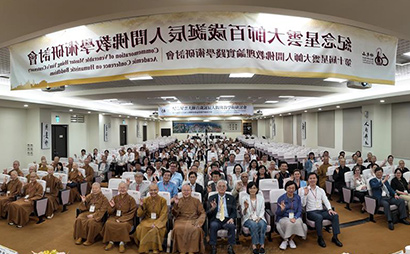
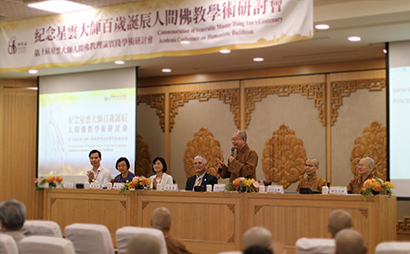
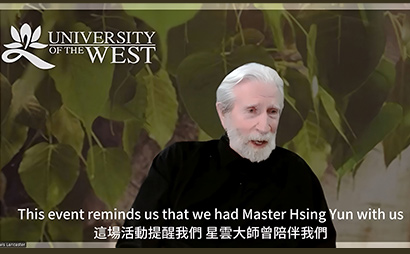
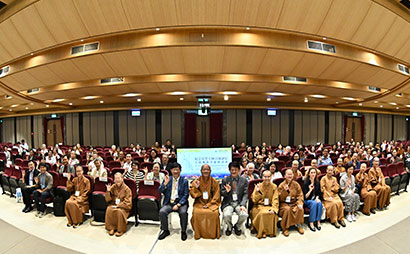
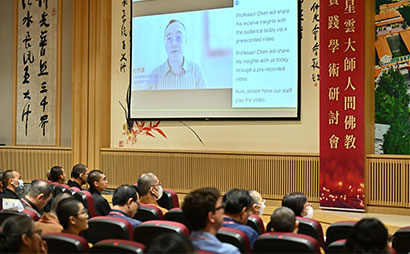
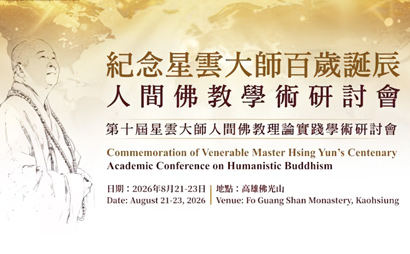
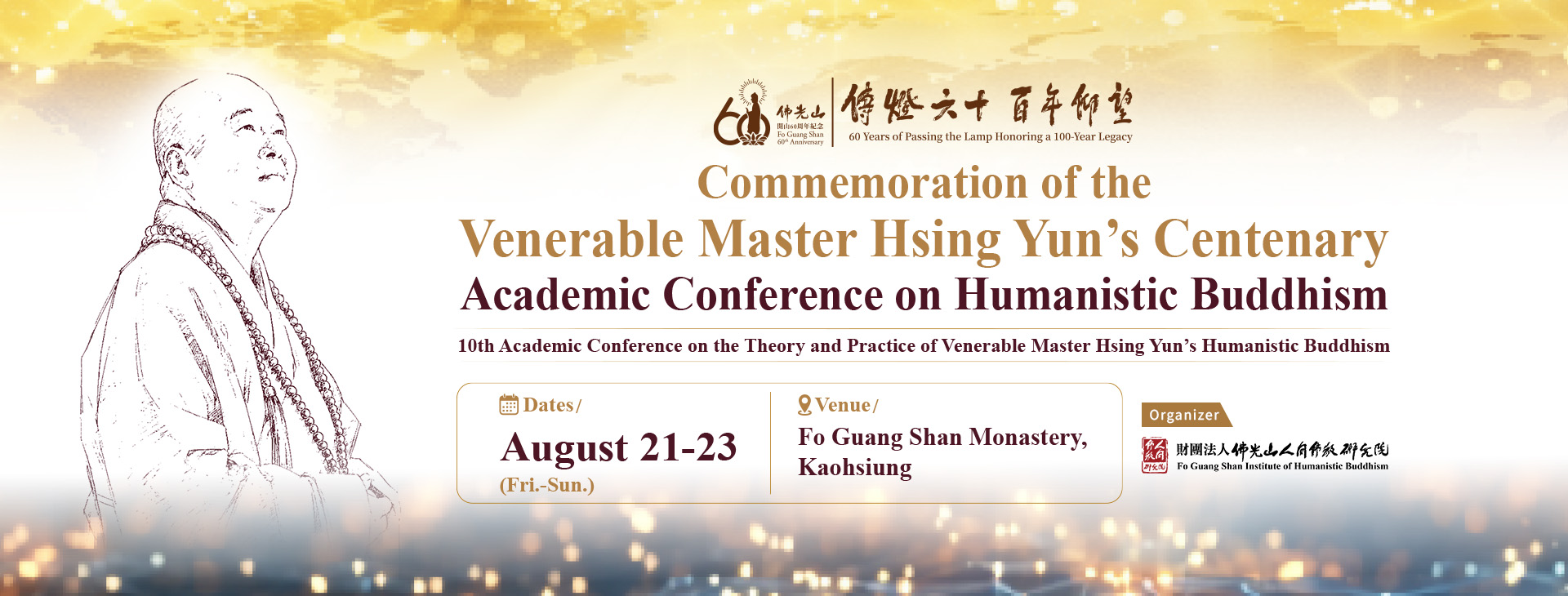
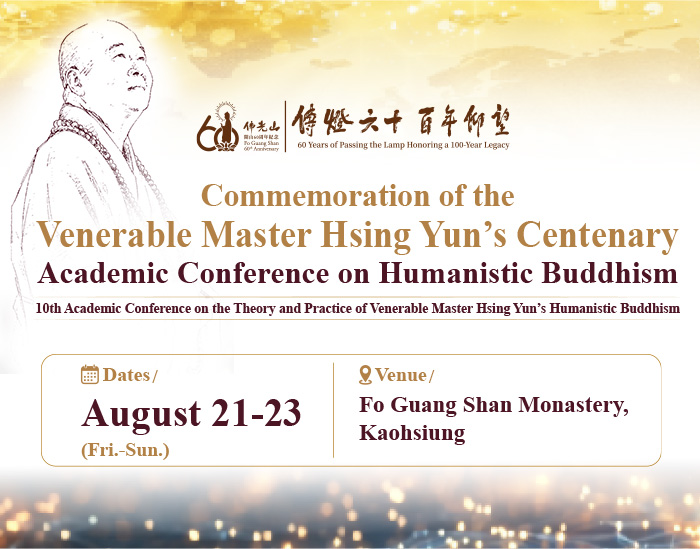
This year marks both the 60th anniversary of the establishment of Fo Guang Shan and the centenary of the birth of Venerable Master Hsing Yun. On this significant occasion, the Fo Guang Shan Institute of Humanistic Buddhism, together with fourteen research centers and affiliated institutions worldwide, is organizing the “Commemoration of Venerable Master Hsing Yun's Centenary Academic Conference on Humanistic Buddhism” concurrently with “The 10th Academic Conference on the Theory and Practice of Venerable Master Hsing Yun's Humanistic Buddhism” under the theme “The Globalization of Humanistic Buddhism.”
The conference aims to systematically examine the global propagation and development of Humanistic Buddhism over the last century, highlighting the institutional experiences, regional characteristics, and theoretical dimensions of Fo Guang Shan's overseas Dharma propagation. From contemporary perspectives including humanistic concern, cross-cultural dialogue, and artificial intelligence, the conference further explores the conceptual resources and practical possibilities that Humanistic Buddhism may provide in responding to global social transformations and diverse challenges.
This conference serves not only as a summary, exploration, and reflection on Fo Guang Shan's sixty-year journey of Dharma propagation, but also as a profound commemoration and tribute to Venerable Master Hsing Yun on the centenary of his birth. Through the clarification of Buddhist thought, the preservation of historical materials, the exchange of experiences, and reflection upon practice, we aspire to carry forward the Master's great vow: “May the Buddha's light shine throughout the three thousand realms, and may the Dharma water flow endlessly across the five continents.” May Humanistic Buddhism continue to illuminate human hearts, foster mutual understanding, and contribute to the cultivation of a harmonious, mutually sustaining, and compassionate world in the future.
Conference Highlights
The conference will focus on the following themes:
01 Intellectual Origins and Theoretical Development
Exploring Venerable Master Hsing Yun's vision of Humanistic Buddhism since the 1960s, including its philosophical foundations, the significance of “I am a Buddha,” and its contributions to comparative religion, interreligious dialogue, and contemporary theology.
02Global Transmission and Local Practice
Examining Fo Guang Shan's Dharma propagation experiences across Asia, Europe, and South America, with a focus on localization, cross-cultural translation, and global dissemination.
03Cultural Forms of Dharma Propagation
Highlighting how Humanistic Buddhism promotes Buddhist culture through texts, arts, media, museums, musicals, translation projects, and artificial intelligence.
04Educational Transformation
Exploring how Venerable Master Hsing Yun's educational ideals have shaped curriculum development, talent cultivation, and modern educational practice.
05Charity and Institutional Practice
Analyzing the development of Fo Guang Shan's charitable initiatives from individual assistance to institutionalized, socially engaged, and global practices.
06Communal Cultivation and Contemporary Dharma Propagation
Examining how Humanistic Buddhism integrates Buddhist teachings into daily life through sports, Buddhist weddings, and other contemporary practices while responding to social, cultural, and technological changes.
07Future Directions for Humanistic Buddhism
Reflecting on the global achievements of Venerable Master Hsing Yun's Humanistic Buddhism and exploring future directions for its continued development over the next fifty years.
Conference Info
Date
August 21–23, 2026 (Friday–Sunday)
Venue
Fo Guang Shan Monastery, Kaohsiung
Organizer
Fo Guang Shan Institute of Humanistic Buddhism
Co-organizers
- Center for Buddhist Studies, Fo Guang University
- Center for Study of Humanistic Buddhism, Nanhua University
- Centre for the Study of Humanistic Buddhism, The Chinese University of Hong Kong
- Humanistic Buddhism Centre, Nan Tien Institute
- Institute for the Study of Humanistic Buddhism, University of the West
- The Centre for Humanistic Buddhism, The Hang Seng University of Hong Kong
- Humanistic Buddhism Research Center, the Philippines
- Humanistic Buddhism Research Centre, Universiti Malaya
- Institute of History of Buddhist Thought and Study of Humanistic Buddhism, Shanghai University
- Religion and Society Research Center, East China Normal University
- Venerable Master Hsing Yun Digital Humanities Research and Development Center
- Fo Guang Shan Humanistic Buddhism Research Center, Japan
- Institute for Humanistic Buddhism Thoughts and Practice, Trinity College, University of Toronto
- Humanistic Buddhism Research Center, Quaid-i-Azam University
Registration
Contact: Ven. Zhi Tong
Tel: 886-7-6561921 #2552
Email: institute@fgsihb.org