Listen to the full story here: https://bit.ly/37wGXEp
Or on iTunes, Spotify, or wherever you listen to podcast.
Once upon a time, there lived a crow in a quiet village. Every day, as he flew around the village, he would greet the people with a series of “Caw! Caw! Caw!” But his caws were harsh and many were scared of him. No matter how much he tried, no one appreciated him.
One day, the crow flew high up into the sky. He circled in the air for a while before he got tired and decided to take a rest. He sat on a tree next to a magpie.
The magpie asked, “How are you today?”
“I’m alright...” The crow answered.
“Where are you going today?” The magpie asked again.
The crow sighed and said, “It doesn’t matter where I am going. Nobody likes me.”
“What do you mean?” The magpie asked.
“The people in my village dislike me, they always complain about how terrible I sound.”
“Oh, is that right?” The magpie sympathized.
“Yeah...that’s why I’m thinking of moving somewhere else since I’m not welcome.”
The magpie then said, “You are a crow, you should be proud of yourself.”
“No, it is because I am a crow, that is the problem! They hate the way I sound.” The crow replied.
“But even if you move to the farthest place, there is bound to be people who don’t like you.” The magpie responded.
“Oh really...then what can I do?” The crow asked.
“The thing is if you don’t deal with the core of the problem, no matter where you go, the problem is still there.” The magpie explained.
“What do you suggest then?” The crow asked.
“Change the way you sound!” The magpie exclaimed.
“It is in my making! How can I change?” The crow protested.
“Of course you can change! Running away from your problem does not solve it, you should face it. Find ways to change yourself because change starts from within.” The magpie said passionately.
In the story, whether or not the crow can ever become like the magpie, what is most important is that one is willing to change. By changing oneself and transforming the way we speak, others will change their perspective on us.
There is an expression in Taiwanese dialect, when we refer somebody’s mouth to a crow's beak, it is to accuse someone of being a jinx, or a bringer of bad luck. In Chinese culture, when your bad luck makes you think there’s a jinx on you, you are believed to be cursed. How would anyone like that?
In Buddhism, there are the five precepts, which are:
1) Refrain from Killing;
2) Refrain from Stealing;
3) Refrain from Lying;
4) Refrain from Sexual Misconduct; and
5) Refrain from intake of intoxicants.
The third precept--refrain from lying, reminds us to guard our speech. We need to learn from the Buddhas and Bodhisattvas, learn from their gentle and loving speech which brings hope and faith to all beings. In the Buddhist sutra, it states that the Buddha has 32 marks of excellence, one of them is having a long and broad tongue, which symbolizes that his words can spread far and wide. The reason why the Buddha has a long and broad tongue is because he speaks with loving-kindness and faith for countless aeons to inspire many people to have the right views.
An outstanding artist can also produce phenomenal drawings of landscapes, people, flowers, and all the beautiful things in the world. These drawings are all created from the imagination of our complex mind. Therefore, our mind is also like a skilled craftsman, having the ability to transform our anger and ignorance into the knives and swords in hell. In contrast, our minds of good will can also manifest as the golden decorations in Amitabha Buddha’s Western Pure Land. As long as we are willing to follow Buddha’s teachings and use compassionate thoughts and minds to paint our inner world, a crow can definitely become a paradise bird, singing blissful music, and resonating with the Buddha, Dharma, and Sangha.
Just as Venerable Master Hsing Yun says,
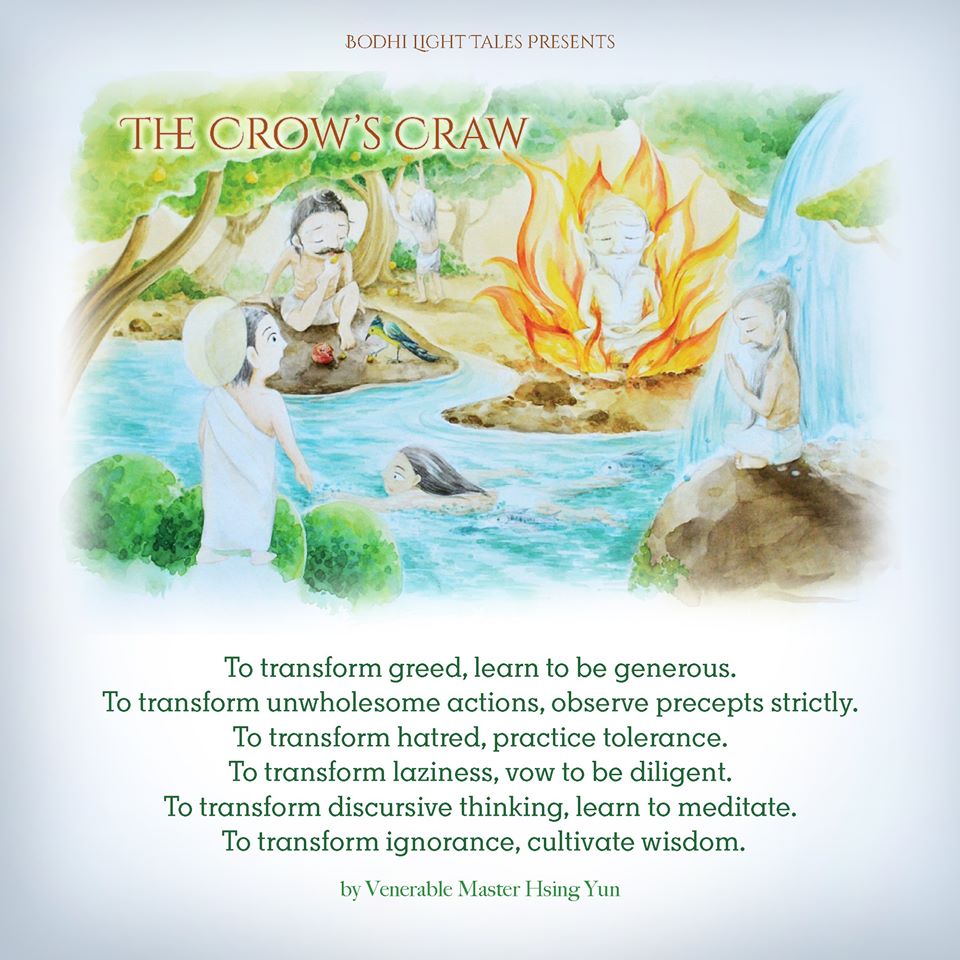
“To transform greed, learn to be generous.
To transform unwholesome actions, observe precepts strictly.
To transform hatred, practice tolerance.
To transform laziness, vow to be diligent.
To transform discursive thinking, learn to meditate.
To transform ignorance, cultivate wisdom.”